


Dov Adler is an audit partner at PwC, a longtime talmid chacham, a teacher, fundraiser, and communal leader. In this conversation, we spoke about growing up in the Adler home, choosing a career, making kiddush Hashem in the workplace, building a serious learning life alongside a demanding job, and what it means to raise children with patience rather than pressure.
The episode has already gotten great feedback, here is a taste.
Growing Up in a Rabbi’s Home
Yaakov:
You grew up in a rabbinic home. You’re a rabbi’s son. Tell us a little bit about what that was like.
Dov:
Sure. I grew up in Teaneck, New Jersey. My father was Rabbi Yosef Adler, z”l, who was niftar this past September.
Overall, I had a very positive upbringing. I had a brother and two sisters, and my parents never forced anything on us. I think that was really the mantra of the home. And although, understandably, a rabbi is busy day and night, I can tell you it was very different from what I see nowadays, because there were no phones.
I always went to shul with my father, even when I was five or six years old. I sat right next to him in the front, stayed for his derashos and shiurim, whatever I could understand and whatever I couldn’t. To me, it was something I was always proud of.
Of course, there were challenges too. We only took two vacations. I tell my kids this all the time. We went to Eretz Yisrael once when I was a kid, and we went to Orlando once. Every other winter break, we stayed home. Sometimes we’d go to his school, and that was some of the fun. So yes, you can imagine there were financial limitations, but we never felt like we were missing out. We never felt like we didn’t have what we needed.
Did You Ever Want to Become a Rabbi?
Yaakov:
You grew up in a rabbi’s home. Did you ever consider following in your father’s footsteps?
Dov:
Yes—I actually did.
I love teaching. Even as a young adult, maybe twenty or twenty-one, when my father would go away, he would let me give the derashah in Rinat on Shabbos. The first time I did it, I was really nervous. Four hundred families, a lot of talmidei chachamim, a high level of learning in the shul—you have to prepare well.
I would go over what I wanted to say with him in advance, and I realized that this was something I liked and could do.
But I also saw the life of rabbanus: constant busyness, every minute of the day, without the financial reward. I wanted a different kind of balance. So I thought seriously about it, and my father actually set me up with members of the shul to talk about finance, accounting, and different professions.
Two things I knew I did not want to do: I did not want to be a doctor, and I did not want to be a lawyer. After that, the world was more open. I chose accounting because it felt more stable. Every job has ups and downs and busy seasons, but it felt reliable. And I realized I could still be fulfilled in other ways—community involvement, serious learning, and teaching—while building a career.
Entering the Workforce as a Frum Accountant
Yaakov:
Let’s talk about work. What was it like starting out as a young frum guy in the accounting world? What shocks did you encounter?
Dov:
I graduated from YU in 1997 and started at Coopers & Lybrand, before the merger that created PwC. I started as an associate in capital markets, working with financial services clients and then developing an asset management and hedge fund practice.
The first big decision I had to make was whether to wear a kippah. In the late 90s, most people did not. When I got there, nobody was wearing one. Another friend and I talked about it, and I discussed it with my father and understood the halachic issues. At the end of the day, I felt more uncomfortable not wearing it than wearing it.
And I felt it would be a good heker for myself going into the workforce—knowing who I am, representing Torah, representing Hashem. So I wore it.
It definitely had an impact. People looked at you differently. Even if they knew you were Jewish, when you’re wearing a kippah in a conference room with fifteen people and you’re the only one, it’s noticeable.
As I became a manager, I wondered: will this affect whether I make partner? I didn’t think so, but you never know. Baruch Hashem, PwC has been a very diverse environment. I made partner in 2008 and was one of the first partners there to wear a kippah. That made me very proud.
Now, looking back twenty years later, PwC is full of people from Brooklyn, Lakewood, Teaneck, the Five Towns—all over—wearing kippot. I’m proud we helped start that
Work-Life Balance, Busy Seasons, and Torah Learning
Yaakov:
How do you think about work-life balance, especially when work gets overwhelming?
Dov:
One of my early mentors said something I’ve never forgotten: work-life balance is measured on an annual basis, not a daily basis. Sometimes it’s monthly. Sometimes it’s over a three-month period.
When I was twenty-four, I was working from eight or nine in the morning until two in the morning, every day, every February and March. That wasn’t changing. I still tried to squeeze learning in here and there. But could I maintain a regular seder with a chavrusa? Not always. This was before Zoom, before remote learning. If it wasn’t in person, it wasn’t happening.
So during those stretches, some things had to give. But then you have to make sure you pick it back up. When life opens up again, you have to use that time properly.
Rav Neuberger speaks about this a lot: when you do have free time, what do you do with it? If you use that time for learning, it shows where your heart really is. And if your heart is there, then HaKadosh Baruch Hu treats the busy periods differently too.
Loving the Work You Hate
Yaakov:
You once said something fascinating: you hate auditing, but you love your job. Can you unpack that? And more broadly, how should people think about choosing a career?
Dov:
The first thing is to establish your goals. What do you want from your career, both short-term and long-term? And what is your attitude?
When I started working, I was twenty-one, newly married, and I had to pay bills. My number one question was: will this job let me support a family and live with some level of menuchas hanefesh? That was the starting point.
Today, I think we sometimes err too far in the direction of, “If I’m not fulfilled, I’m not doing it.” Of course a job should have some fulfillment. But we all know what the obviously fulfilling jobs are—doctor, rebbe, rav, therapist, and so on. What I try to do is find fulfillment even in a job that doesn’t seem fulfilling on the surface.
I’m an audit partner at PwC, and I say this all the time: I don’t like auditing. I actually hate auditing itself. The technical work, the checking, the opinions—I don’t love that. But what I do love is teaching, mentoring, reflecting, business development, getting new clients, building relationships.
Those are the same skills I enjoy in teaching Torah.
So I tell people: don’t only look for fulfillment in the title of the job. Sometimes you bring the fulfillment into the role through mentoring, helping others, building, teaching, referring people, giving back. At the same time, you have to be realistic. Life is expensive. You need to weigh passion against the actual needs of your family.
Building a Learning Life That Lasts
Yaakov:
Looking back, what helped you maintain Torah learning through the ups and downs of work and life?
Dov:
Consistency. And specifically: having a chavrusa.
You need someone who holds you accountable. Morning or night, you need a fixed relationship with someone. I used to try to learn early in the morning, but that wasn’t always for me. I missed too often. What really anchored me was a night seder.
When you have a chavrusa, your day gets planned around learning. Even today, with Zoom and FaceTime, it’s easier than ever. In earlier years, if you weren’t there in person, that was it.
I also believe a person should have two sedarim: a formal one and an “on-the-go” one. Have a pocket Mishnah. Have something small you can learn while waiting around. People joke about a “shalom bayis seder”—when your wife is getting ready for a simchah, learn another Mishnah.
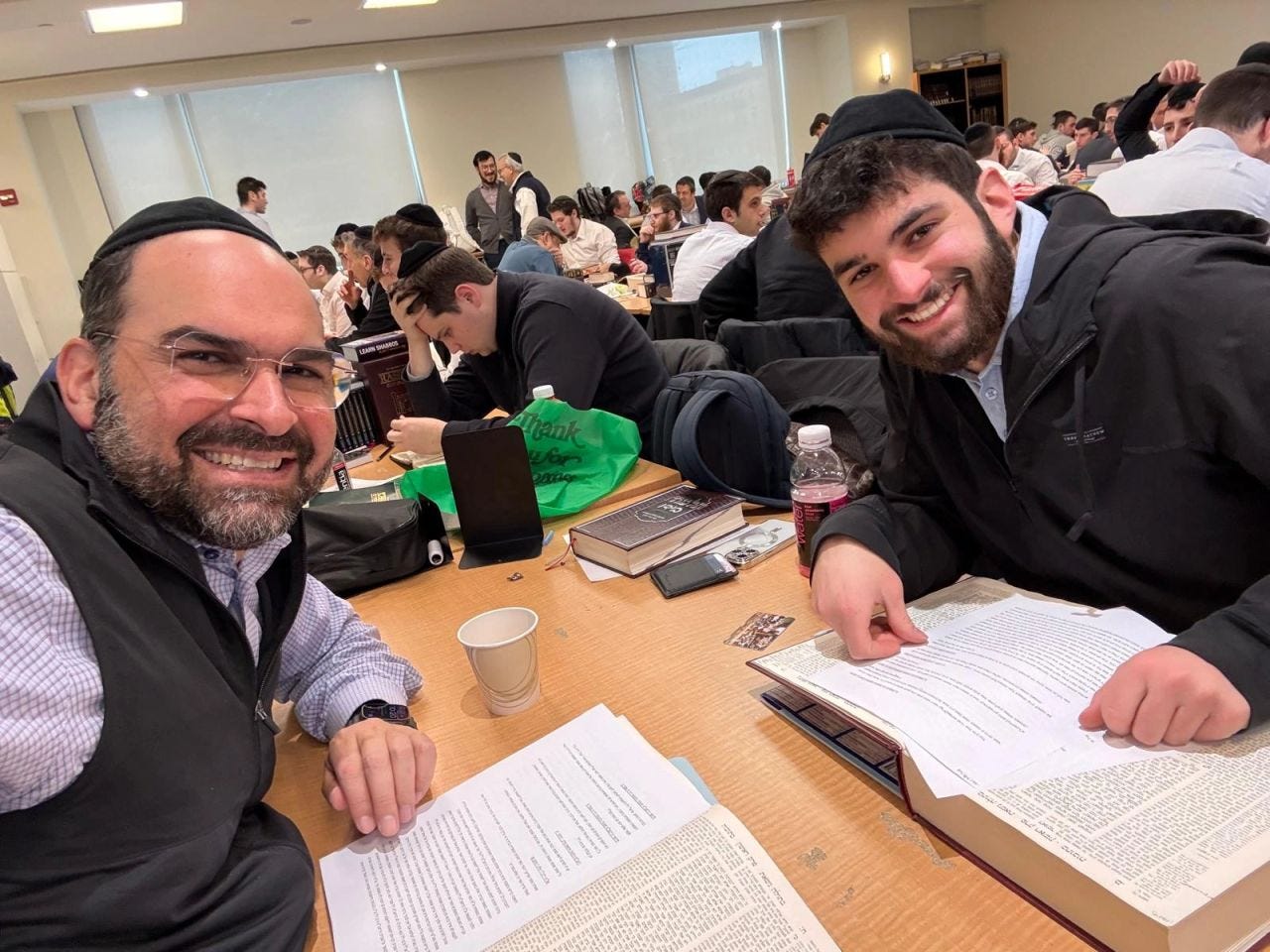
And as your career progresses, you may get more time back. As kids get older, you may get more time back. Right now, one of the greatest things in my life is that I am my son’s night seder at YU.
At first I wasn’t sure that was the right choice. Maybe he should learn with someone his own age. But Rav Neuberger told me, “If your son is asking you to be his night seder, and you can do it most of the time, grab the opportunity.” So I did.
That’s a tremendous gift.
Don’t Be Afraid to Bribe Your Kids
Yaakov:
You told me once the story of how that learning relationship with your son began. Can you share it here?
Dov:
This is a great story. My son will kill me for telling it, but I’ve already said it publicly enough times.
He was a senior at TABC and, to put it mildly, not so into learning. Great kid, good boy, hockey player—but not so into learning. Around that time he told me, “Abba, I’d love a car as a senior.”
My lease was coming up, and I realized I had an opportunity to bribe him. I grew up in a house where my father was a big briber. For me, it was baseball cards. Come to shul Sunday morning, get two packs of baseball cards. That worked.
So I told my son: if you learn an hour a week with me for the entire year and finish Maseches Taanis, I’ll extend the lease on my car for a year and give it to you.
He thought seriously about it, because he’s a man of his word. Then he said yes. We learned the whole year, finished the masechta, and made a siyum. At the siyum he said, “I started learning for the car. But halfway through, I don’t know when it changed—I just realized I love learning with you.”
That changed everything.
The next summer he went to NCSY Kollel. For the first two weeks in Israel I learned with him in the mornings. Then I came back to America, and he no longer had a chavrusa for the rest of the program. So for three weeks, I went to sleep at eight or nine at night, woke up at one in the morning, and learned with him from two to four a.m. every day. We finished the eighth perek of Bava Metzia.
People told me I was crazy, that I was a legend. But I’m not saying it to praise myself. I’m saying: when kids see that you value learning enough to do crazy things for it, it makes a deep impact.
And yes—don’t be afraid to bribe your kids.
Parenting Without Forcing
Yaakov:
That connects to something bigger. How do you think about being patient with children—allowing for ebbs and flows, not getting too frustrated, staying loving and present through it all?
Dov:
I think the key is to set an example and present alternatives without forcing.
That was how I was raised. My father never forced me to do things, but he always made clear what he thought was right. Every Sunday morning, I wake my son up for minyan. Will he go every single time? No. But I wake him up. He knows there’s an opportunity. He goes a lot.
The same is true in many other areas. I’m not going to pretend I think it’s ideal for a kid to sit in his room on his phone longer than I’d like. Of course not. You need boundaries. Filters matter. Structure matters. But forcing often backfires.
Especially today, when the distractions and the bad influences are so close and so accessible, you cannot afford to turn a child off by pushing too hard.
Rav Druk says a father who spends the whole time shushing his kid in shul will often end up with the exact opposite of what he wants. Better to daven properly yourself, show what it means to stand before Hashem, and let the child absorb it. If the child quietly looks at an English book in shul so that he can be there with you, kol hakavod. Don’t turn it into a war over page numbers in the siddur.
Model what you want. Present what’s right. But don’t force.
Teaching Children to Daven
Yaakov:
That brings me to a personal question. I have little kids, and I’ve been thinking ahead to the challenge of having children in shul while also trying to daven properly myself. How do you think about balancing your own avodah with chinuch?
Dov:
Let me start with a story about my father.
When he was principal of TABC, someone once asked him about a struggling child and said, “How do you get the kids to daven?” My father answered, “Why would a kid want to daven? He has everything he needs. There’s food on the table, his parents have jobs, he has clothes, he has a comfortable life. Why would he feel a need to daven?”
The man walked around the desk and hugged him.
That perspective matters. We have to understand where kids are coming from. Davening is hard. Even for adults. So for kids, of course it’s hard. Why would Refa’einu mean much to them if they never dealt with illness? Why would Bareich Aleinu mean much to them if they don’t feel the pressure of parnassah? Why would Et Tzemach David feel concrete?
So don’t expect them to feel what you feel. Train them slowly. Focus on one brachah. One idea. One point of connection.
Before a hockey game, I tell my son: have a good Shemoneh Esrei today, and in Shema Koleinu ask Hashem to help you play well. I’m not saying hockey is the highest thing in the world. I’m saying: if that matters to him, teach him that davening means asking Hashem for what matters to you.
That builds the muscle memory of tefillah.
Teaching Torah While Building a Career
Yaakov:
You love Torah, public speaking, and teaching. How did that part of your life start expanding, especially while staying busy professionally?
Dov:
I’ve always loved teaching. Three years ago, I gave a shiur between Minchah and Maariv, and someone said, “Would you be willing to give a weekly Chumash shiur?” That became a Thursday night Zoom shiur for Beth Abraham.
I think iyun in Chumash is a bit of a lost art. People focus on Gemara, hashkafah, or hot topics, but every week we take one pasuk, one idea, and really develop it. We get ten to fifteen people live, and then many more listen later on YUTorah.
It gives me a lot of chiyus. And as you become more senior in your career, the pressure doesn’t disappear, but the flexibility changes. I’m not working until two in the morning anymore. So I can use that flexibility for teaching.
It takes a lot of preparation. Giving shiurim is a serious investment of time. But it keeps me focused on the parashah all week. It sharpens me.
I also started two daily WhatsApp chats. One is a short daily Chumash and inyana d’yoma piece—under three minutes, always under three minutes. The other is a daily bitachon chat. We started with Chovos HaLevavos and then moved on. Again: under three minutes. Small, digestible, but consistent.
And I really believe this: the more a person learns, the more HaKadosh Baruch Hu helps him be successful at work. I wouldn’t be able to do this today if I hadn’t put in the work when I was younger.
Why Nonprofit Work Became a Passion
Yaakov:
Let’s shift to the nonprofit side. You’re involved in a lot of initiatives. How did that start, and which projects are you most proud of?
Dov:
I’ve always been involved in nonprofits. Once my daughter started school, I got involved right away. I felt it was important to give back. That came from my parents. My father obviously, but my mother too—she was very involved in schools, PTA, organizations.
Once I started, I realized I really like this work. It fits my personality: helping organizations grow, helping people, building things.
Over the years I became treasurer and later president of Yeshivat Noam, got involved with Maayanot, Beth Abraham, TABC, and other institutions. I also got into fundraising, and I realized that’s a skill I had developed.
I’ve helped fundraise for multiple schools and buildings. I helped lead the campaign for the TABC building, which was named in memory of my father. I helped start Yeshiva Shalshelet for children with language-based learning disabilities. I didn’t have a child who needed it—I was just approached because people thought I could help get it off the ground. Today it has around sixty students and is doing remarkable work.
More recently, I helped start KFAR, an after-school program for children in public school who need more Jewish structure and support. This year we had our first siddur play. Seeing grandparents cry because they never imagined their grandchild in public school would have a full siddur ceremony—that was one of the most emotional things I’ve ever seen.