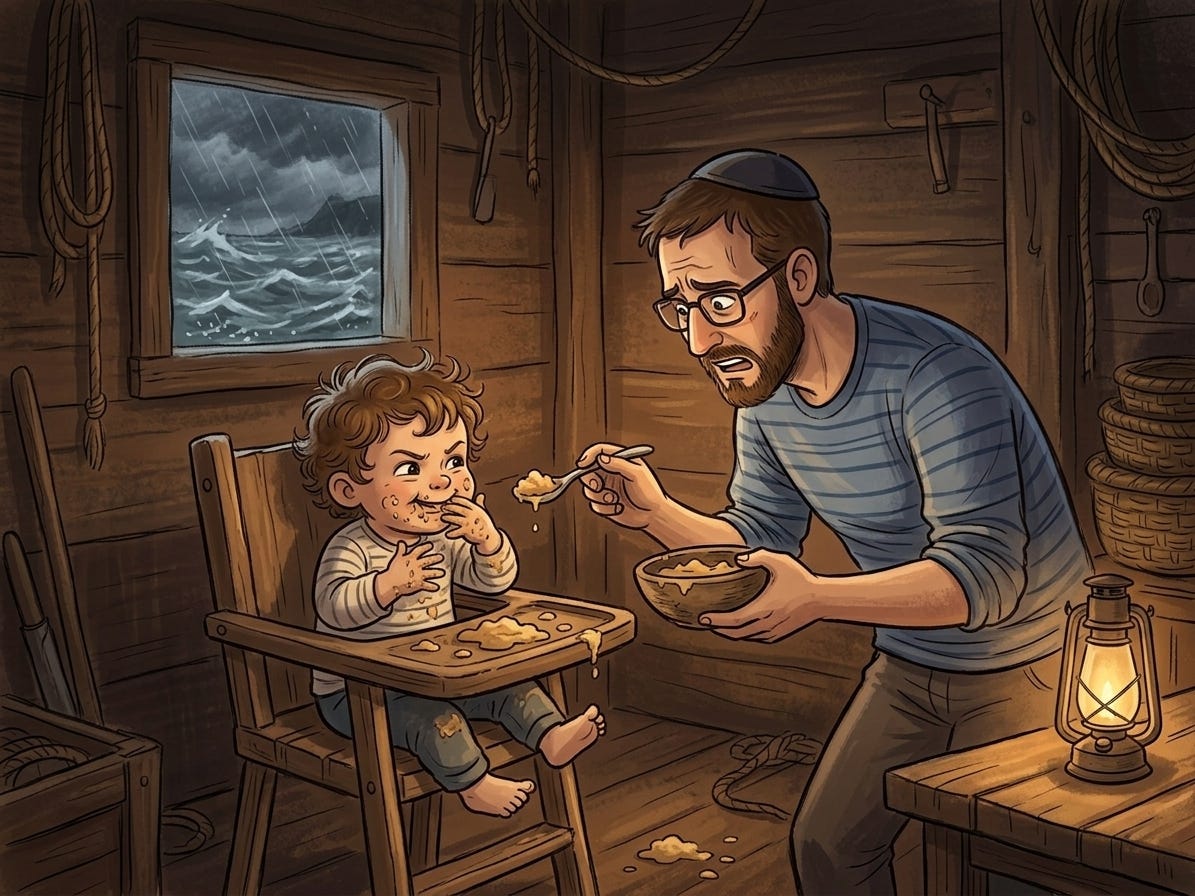
Noach makes an appearance at one of the holiest times of the year. In Mussaf on Rosh Hashana, the first of the pesukim in zichronos describes God remembering Noach in the teivah.
וַיִּזְכֹּר אֱלֹהִים אֶת־נֹחַ וְאֵת כׇּל־הַחַיָּה וְאֶת־כׇּל־הַבְּהֵמָה אֲשֶׁר אִתּוֹ בַּתֵּבָה וַיַּעֲבֵר אֱלֹהִים רוּחַ עַל־הָאָרֶץ וַיָּשֹׁכּוּ הַמָּיִם׃
God remembered Noah and all the beasts and all the cattle that were with him in the ark, and God caused a wind to blow across the earth, and the waters subsided.
What is the connection here? There seems to be a fundamental gap between the essence of zichronot and the passuk that is quoted.
The Gap
What is the bracha of zichronot all about? First, let’s clarify what zichronot is not. I often forget to do various tasks that my wife asks of me, and need to be reminded. This is a result of human fallibility, but Hashem doesn’t forget like that. Rather, Rosh Hashana is a day of judgement. We hope and pray that during this crucial time we will be judged favorably. We aren’t asking for a free pass or an unnecessary pardon. Rather we are asking that the focus be on the good things we have done.
Now let’s go back to Noach. The simplest read of the Noach story is that Noach was good, the generation was bad. The flood wiped out all the bad guys, while the good guys waited things out in the teivah. The passuk that opens zichronos comes after 40 days of flooding and 150 days of additional destruction.
Was Noach the subject of divine judgement? Certainly. While the rest of the world was found guilty, Noach was worthy to survive the flood and restart humanity.
But if this is true, Noach was judged before the flood. Therefore, we might expect to find a passuk about God remembering Noach before he commands him to build the ark.
But the passuk that we actually have in the chumash, which we say in zichronot, comes in the middle of the flood. All of the people and animals left on earth have already been wiped out. Noach and his family are waiting things out in the teivah. And then Hashem remembers. What was God remembering at that point in the story?
The Second Test
Maybe this passuk is teaching us that there is another layer to the story. People oftentimes behave differently in different contexts. Sometimes people behave very admirably in public, but being around their family brings out the very worst of them.
I once observed a Rebbi walking with a talmid. They were walking side by side, talking excitedly in learning. The Rebbi‘s young son approached his father from the other side to ask him a question. The following sequence took a split second, but it was seared into my memory. The Rebbi swiveled his head 180 degrees, barked something impatiently at his son, then returned his focus to his talmid. Within a few moments I saw a totally different part of this man’s personality, and it was gone as fast as it came.
If I’m being honest, I am probably guilty of this as well. For various reasons, it can be much harder to manage your own little kids, as opposed to managing big crises or major projects at work.
What does this have to do with Noach? Walking around the streets of an evil and corrupt society, Noach was perceived as a righteous man. But did that really reflect sufficient inner purity?
The time in the teivah would provide an answer to this question. Without any publicity, lacking any evildoers to position himself above, being isolated with his family, how would Noach behave?
If he indeed possessed sterling character, that would express itself even in isolation. But if his previous behavior was all about his own ego, he would quickly unravel in a boat alongside just his family and a bunch of animals.
Alternative Endings
This was the test of the teivah. Noach was being watched and judged. If this was actually a judgement, there must have been alternative endings to this story. What would have happened if Noach had not been successful in this test?
For starters, the timing of the flood was not predetermined. When God tells Noach to enter the teivah, he never promises an end time. It could be that Noach’s behavior proved that he could be let out without further delays.
But a careful read of the pesukim allows an even more radical suggestion. God never promises Noach that the mabul will end. In the lead-up to the flood, Hashem never says that humanity would restart with Noach as the founding human.
Maybe if Noach failed his test, he would live out his life in the teivah, only to die there. Then Hashem would need some other plan, without Noach.
Chazal teach us that there was no marital intimacy in the teivah. The simple reading of that teaching is that it was a time of distress, therefore such behavior is prohibited. But according to our reading, God was not yet sure that humanity should continue from Noach and his family. That was only decided during the flood, when God saw how Noach behaved in isolation.
This second suggestion, that Noach’s survival was not guaranteed, would not be accepted by all Rishonim. In the lead-up to the flood, the passuk says:
וַהֲקִמֹתִי אֶת־בְּרִיתִי אִתָּךְ וּבָאתָ אֶל־הַתֵּבָה אַתָּה וּבָנֶיךָ וְאִשְׁתְּךָ וּנְשֵׁי־בָנֶיךָ אִתָּךְ׃
But I will establish My covenant with you, and you shall enter the ark, with your sons, your wife, and your sons’ wives.
(Bereishis 6:18)
What is this covenant? Rashi gives two possible interpretations. One is that there was a covenant that Noach would successfully enter the ark, without being killed by the wicked of his generation. The second is that the fruit in the teivah would not get moldy. But the Ramban disagrees, and says that this was a covenant that Noach would survive the mabul and live beyond it. The Ibn Ezra, Seforno and Netziv also have similar understandings.
According to Ramban and others, this covenant does in fact allude to a promise God made to Noach that he would enter the teivah, and exit it after the mabul ended.
But according to Rashi, the only promise God made pertained to either entering the ark, or avoiding smelly rotten fruit while inside. Therefore there was no previous commitment to Noach’s survival.
This would help us explain the zikaron and the judgement which we mention on Rosh Hashana. Even after spending months floating in the ark, Noach was still on trial. God had not yet decided if Noach was worthy of continuing humanity.
And what was it that proved his righteousness? It was his behavior in private, without others to impress. It was the way he treated his family, the ones who deserve our best but sometimes get our worst. These were the qualities that proved who Noach really was.