


For the second time this week, I am jumping into controversial waters. (The first adventure was my podcast episode about going up to Har Habayit.)
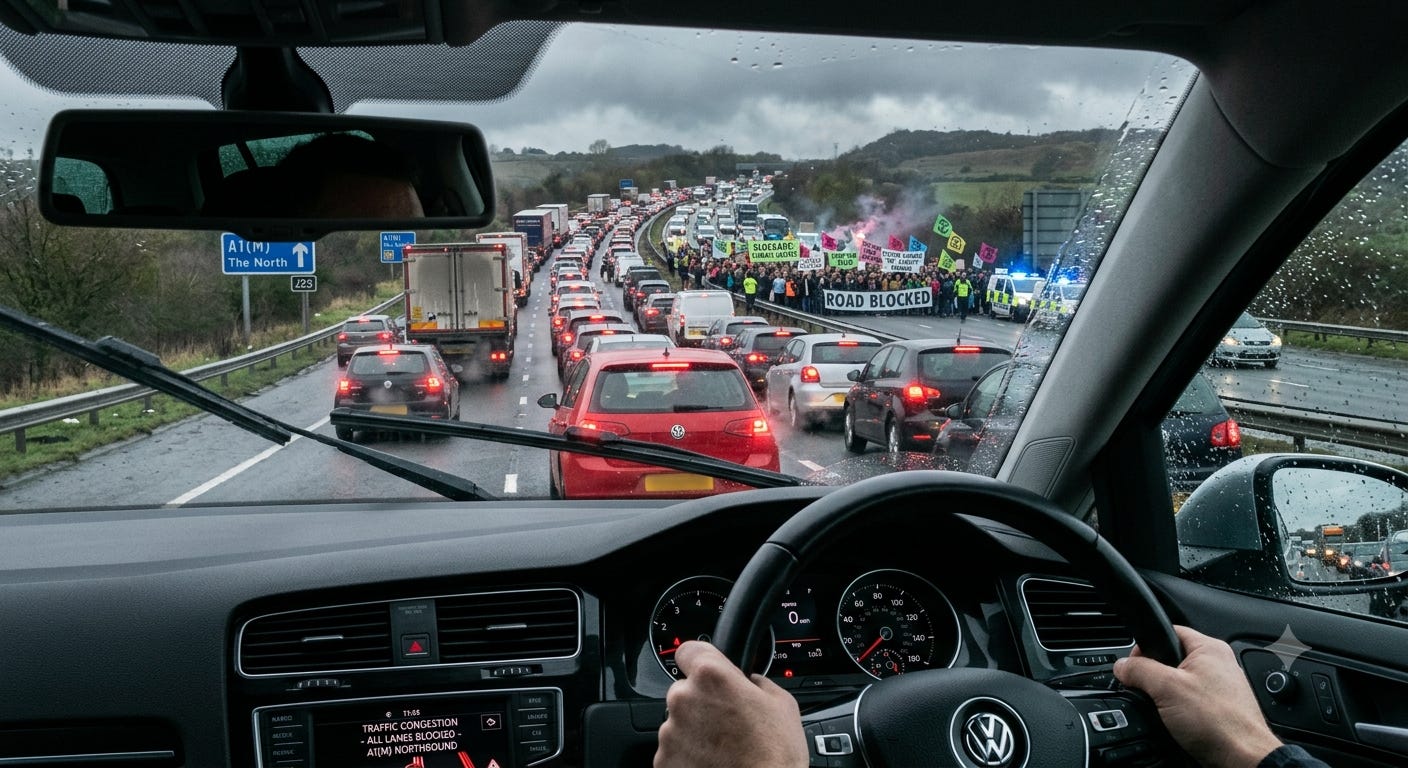
This post will deal with a halachic question and it’s hashkafic ramifications: If a person comes late to work due to traffic, and the traffic was a result of a road blocking protest, does the protester need to pay damages? A related, juicier, separate question: can the tardy employee get out of his car and punch the protester to get him out of the way? Is this legitimate self-defense?
I usually avoid clickbait and divisive political topics, but this case is directly tied to Shtark Tank. That’s because this sugya is a halachic expression of the Torah’s approach to work. (The place where I discovered this sugya, plus an interesting life hack, is in the footnote.)1
I want to clarify that this is not meant to be practical halacha, and not a post about the legitimacy of the protesters, police, or anyone else. I am not a dayan, and don’t feel the need to weigh in on political issues. But one of the relevant sources in the gemara will suffice to give us a glimpse into this sugya
.
A person who damages another person is liable to pay five different payments: nezek (loss of value as if he were a slave), ripui (medical costs), tzaar (pain), boshet (embarrassment), and shevet (loss of work). The gemara on Bava Kamma 85b says that each payment could be incurred independently. How could shevet be caused without any other damages? The gemara describes a case where one person locks another person in a room, causing them to miss work.
The Rosh says that this is only true if the damager brings the victim into the room and locks him up. But if the employee was already in the room, that is a grama, and the damager would not have to pay.
The Ramban and other rishonim might disagree with this. The Ramban (Kuntres Dina D’Garmi) writes that shevet is not even garmi, since there is no disagreement like in other cases of garmi (where Rebbi Meir disagrees with the chachamim). He explains that at the moment a person misses work, it is considered hezek nikar.
ואי קשיא לרבנן דלא דייני דינא דגרמי היכי מחייב והא גורם הוא לבטלו ממלאכתו וגורם הוא לו שלא ירויח, לא קשיא דכיון דהרזקיה מההיא שעתא הוא דאפסדיה עד דפתח ליה והא אמינא דהיזק ניכר נמי הוא ובין לר”מ ובין לרבנן חייב
The Shulchan Aruch (CM 420:11) paskens like the Rosh. But it’s important to understand the nekudat hamachloket here: what exactly are the rishonim arguing about?
It seems clear to me that the machloket between the Ramban and the Rosh is about the liability of the mazik, not about the existence of nezek. My Rebbe, Rav Moshe Stav, used to say that for there to be a chiyuv tashlumin, you need three things: mazik, nizak, and nezek. Getting back to our sugya, the Rosh doesn’t say that a loss of work isn’t nezek. He just says that if the mazik isn’t active, it is considered grama, and the mazik isn’t directly responsible for the nezek. But it seems clear to me that they both agree with the Ramban’s definition: loss of work has the status of damaged property.
And that’s the fundamental idea: the loss of work is considered nezek. It’s like a smashed window. How could that be?
I would like to suggest that the five tashlumin that are paid when man damages man correlate to four parts of a person. There are different aspects to a person’s self, and each part can potentially be damaged. There is physical damage (nezek and ripui), psychological damage (tzaar), emotional self-esteem damage (boshet), and shevet. We see in the payment of shevet that a person’s ability to work is a core part of his identity, just like the others. Therefore, taking away a person’s ability to work is considered actual damage.
This makes perfect sense in light of the fact that man was created and immediately put to work.
ויקח ה’ א-להים את האדם וינחהו בגן עדן לעבדה ולשמרה
We see from here as well that a person’s work is a core part of his mission here on earth.
Based on all this, it would seem to give self-defense rights to the employee running late for work. If we assume that loss of work is nezek, and each moment of lost work is ongoing additional damage, then the damaged person should be allowed to remove this threat that is on him.
Lchora this would be completely independent of any chiyuv. Even if you assume that the protester doesn’t pay (because it’s like the grama of the Rosh, or because the protester isn’t directing his act at one particular person, or any other reason), that should be irrelevant here. The fact is that there is a nizak who is experiencing ongoing nezek, and therefore he should be allowed to defend himself.
Here’s a life hack if you want people to think that you are really smart: read footnotes. Just the footnotes. You can skip the actual book or essay. Footnotes are often self contained bubbles of wisdom, and quoting a footnote in conversation is a power move.
Now that I have revealed my secret, I wanted to give credit to Rav Tzvi Goldstein. A footnote in his recent post triggered brought my attention to this sugya.
This skips the most basic point which is that it's assur to attack someone for causing one any of the avos nezikin, the category of self-defense just doesn't apply to shevet so the whole premise is bunk. Why would you write this needlessly incendiary article with a halakhic conclusion that no one agrees to and you don't even make an effort to defend? Blocking or protesting on a highway in Israel is illegal but it doesn't clearly fall into a category of nezek and doesn't make it mutar to attack another Torah-observant Jew Ch"V! Did your rabbis teach you this? "Therefore he should be allowed to defend himself" - is this your feeling or your opinion on the halakha? Even for a cut-and-dry case of nezek it's assur to attack someone even to stop ongoing financial damage. Also you just handwaive away the whole point which is that we pasken that this type of damage would be grama and so there is no true nezek going on in the first place! So on what possible basis would you permit one to attack another Jew on the basis of grama by protesting in a democracy (albeit in a disruptive way)? You say you're not giving psak halacha but then you say "he should be allowed to defend himself" meaning, I presume, that you would be okay with someone getting out of their car and beating a protestor until he's incapacitated? Is that correct?
Your intellectual acrobatics and false lomdus in the first part of the post mask a seriously disturbing conclusion which is that you are distorting halakha to permit damage to another Jew in a case where no heter applies. Do any poskim hold like you that you can attack another Jew for indirect financial damage caused by protest or are you simply trying to stir people to break Torah law because of your personal frustration? You should do teshuva and take this post down if you care about Torah and halakha. לֹא־תְקַלֵּ֣ל חֵרֵ֔שׁ וְלִפְנֵ֣י עִוֵּ֔ר לֹ֥א תִתֵּ֖ן מִכְשֹׁ֑ל - you're directly leading people into a scenario where they could cause real nezek to someone in a way that is forbidden by Torah law.