


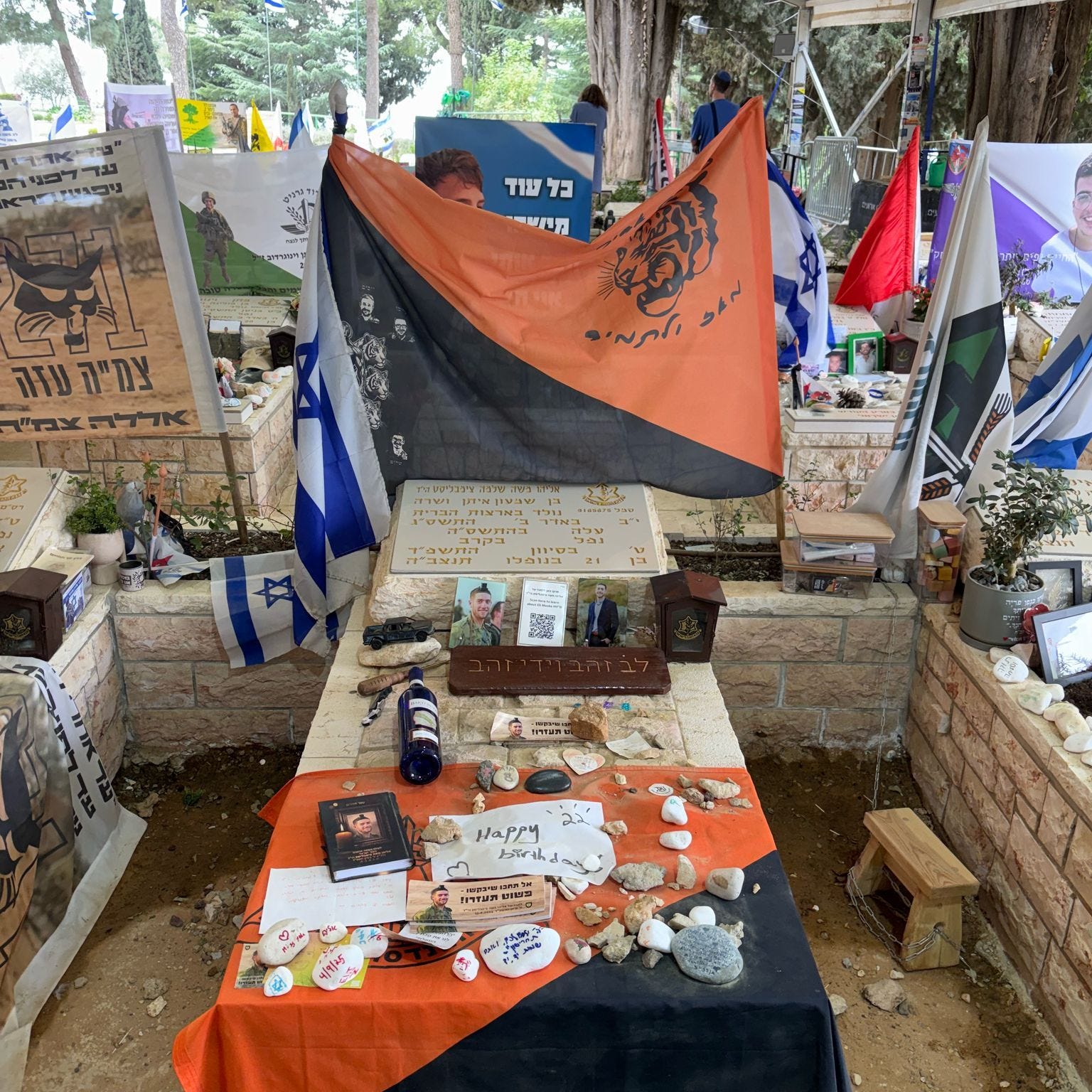
Today marks the second yahrtzeit of my brother-in-law, Eli Moshe Zimbalist HY”D. Eli Moshe waas killed in Rafah while returning from a misson on Shabbat Morning, along with 7 other comrades. He fought as a combat engineer, and was a Hesder Student at Yeshivat Shaalvim.
The following is an adapted version of thoughts which I shared at Her Hertzel this morning. Eli Moshe was a skilled builder. Despite his young age, he had managed to build hundreds of sukkah pergolas, yard decks, and pieces of furniture. This is why I chose to speak about building.
When seeking to understand a certain Torah concept, it's always interesting to examine its first appearance in the Chumash. Where does the word בנה, building, first appear?
The very first appearance is when God takes one of Adam’s ribs and uses it to ‘build’ the first woman. When is the first physical building built?
וַיֵּדַע קַיִן אֶת אִשְׁתּוֹ וַתַּהַר וַתֵּלֶד אֶת חֲנוֹךְ וַיְהִי בֹּנֶה עִיר וַיִּקְרָא שֵׁם הָעִיר כְּשֵׁם בְּנוֹ חֲנוֹךְ:
Kayin knew his wife, and she conceived and bore Chanoch; and he was building a city, and he called the name of the city after the name of his son, Chanoch.
Gen. 4:17
Immediately after the killing of his brother and ensuing punishment, Kayin builds a city and names it after his son Chanoch.
This passuk often gets overlooked. It’s just one verse towards the end of a long parsha. We read it after the entire story of creation, the dramatic sin of Adam and the fascinating story of Kayin and Hevel. Yet this one line contains many important lessons
.
Three Lessons From the First City
The first thing to notice is that it doesn’t say he built the city, in past tense. Rather he was continuously involved in development, ויהי בונה עיר (”and he was building a city”). This reminds me of the advertising slogan for Lowe’s, the home improvement store: never stop improving.
The second idea can be found when taking a step back and considering the context of this story. Kayin was cursed that he would not be able to properly work the land. So he built a city. Rav Hirsch explains that a farmer relies on the earth. He uses his skills to maximize the potential of the natural resource.
But in the city, their only source of work is man himself. Human creativity is the basis of any city. That’s why it’s called עיר, like the word להתעורר (”to awaken/stir oneself”), because man innovates and creates his own opportunities, without relying on the fields.
And finally, this project of Kayin came immediately after a multi-part crisis. His korban was rejected. He killed his brother. He was cursed by God. After all of that, he decided to build. In fact, according to some mefarshim he wasn’t even able to benefit from the city himself, since he was cursed to live on the run. That’s why he named the city for his son, because Chanoch was the one who was actually going to live in it.
Building a Man
We pointed out that the first time the root בנה (to build) is used, it is a description of Chava. We also know that when Sara thinks she can't have children, she tells Avraham to marry Hagar, אולי אבנה ממנה ("perhaps I will be built up through her"). I think the three aspects of building mentioned above are relevant to the building of a person as well.
The first was to be in a constant state of growth and development. A person must always continue to learn new things and improve his personality. The second was the ability to innovate and create opportunities. People have various forms of outside help and support at different points of their life. But there needs to be an underlying understanding of אם אין אני לי מי לי ("if I am not for myself, who will be for me?"). A person must have self-esteem which doesn't rely on outside validation, and be able to draw upon that in times of need.
And finally, building after a crisis. The Hebrew word for crisis is משבר (mashber), which also means a birthing stool. A person is born in an act of great pain. But this pain is the start of a long, great journey. We learn from this that after a crisis, we must build.
Remembering Eli Moshe
I think these three things are also true of Eli Moshe HY”D. He loved learning new things, especially when it came to building. New projects, new tools and new ideas were constantly exciting him. He was also extremely creative, always coming up with solutions to various problems. When there was no help coming in the form of outside solutions, he dug deep inside himself to figure it out.
And finally, building after crisis. Eli Moshe’s death was a tragedy. Two years ago today, our hearts were shattered. And even though the passage of time helps a bit, nobody who knew Eli Moshe, will ever be the same.
And yet Eli Moshe told us that his death was not an excuse to let ourselves falter. And after the crisis came the building. A new shul which is almost ready. A new park near Gan HaPlastic. New chessed projects. After a crisis, we build.
We stand here amongst the graves of hundreds of heroes. Each death left hundreds of broken hearts. Comrades, friends and co-workers, mothers, fathers, siblings, spouses, children. Just like Kayin, they made the sacrifice to help build something that they themselves wouldn’t benefit from. It is our responsibility to continue their legacy, to continue building.
What are we building?
A better future. A new day for this country and this nation. A new chapter in our nation’s glorious history.
Building is not easy.
It’s expensive, noisy and difficult.
But this is what we have to do.